
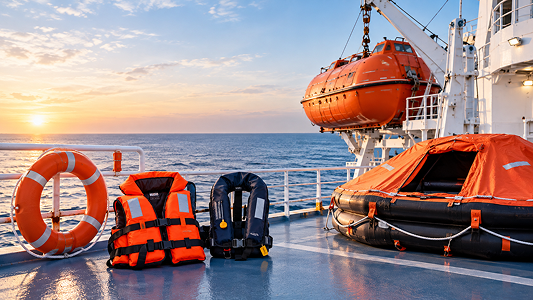
Life-saving equipment is a critical part of safety onboard ships. In an emergency, crew members and passengers may need to abandon a vessel quickly, and the availability of suitable equipment can make a significant difference to their safety.
Lifejackets, lifeboats and liferafts serve different purposes during an emergency. Lifejackets help keep individuals afloat, lifeboats provide a means of evacuation, and liferafts offer a floating survival platform after abandoning ship.
For shipowners and vessel operators, choosing the right equipment involves understanding the vessel's requirements, applicable maritime regulations and the maintenance needed to keep each system ready for use.
What Are Lifejackets and Why Are They Important?
Lifejackets are essential life-saving appliances designed to provide buoyancy and help keep the wearer's airway above water. They are used during man-overboard incidents and vessel abandonment, depending on the situation and onboard safety procedures.
The choice of lifejacket depends on the vessel, operating environment and intended use.
Types of Lifejackets Used at Sea
Inherently buoyant lifejackets: These use materials such as foam to provide flotation without requiring inflation. Their simple operation makes them suitable for situations where immediate buoyancy is important.
Inflatable lifejackets: These use an inflation mechanism to provide buoyancy when activated. Depending on the design, inflation may be automatic or manual. They are often selected where compactness and freedom of movement are important.
Specialised lifejackets: Certain designs are developed for particular maritime applications. Buyers should check the product's approval, buoyancy performance, fit and compatibility with other personal protective equipment before selecting a model.
When sourcing lifejackets, businesses should check product documentation, applicable approvals and servicing requirements. Working with experienced life jacket manufacturers can also help buyers obtain technical information relevant to their operational needs.
What Are Lifeboats Used for on Ships?
Lifeboats provide a means of evacuating people from a vessel during emergencies. Depending on the vessel and the type of lifeboat, they may be designed to accommodate occupants in a protected enclosure and support survival after launch.
Lifeboats must meet the requirements applicable to their intended use, including capacity, launching arrangements and relevant approval standards.
Types of Lifeboats
1. Enclosed Lifeboats
Enclosed lifeboats have a protective enclosure around the occupants. They are designed to provide protection from environmental exposure during evacuation and subsequent survival at sea.
2. Free-Fall Lifeboats
Free-fall lifeboats are designed to be launched from a vessel using a controlled free-fall arrangement. They are commonly associated with certain offshore and specialised vessel applications.
Their installation requires suitable launching arrangements and compliance with the relevant design, testing and operational requirements.
3. Other Approved Lifeboat Designs
Lifeboat configurations vary according to vessel type, operational requirements and applicable regulations. Selection should consider passenger capacity, launching systems, available installation space and the vessel's safety arrangements.
When evaluating lifeboats for sale, operators should look beyond the initial purchase price. Product approval, capacity, compatibility with the vessel, installation requirements and after-sales support are equally important considerations.
Understanding Life-Raft Systems
Liferafts are designed to provide a floating survival platform for people who must abandon a vessel. They are commonly stored in containers and deployed during an emergency using the arrangement specified for the vessel and equipment.
Unlike lifeboats, liferafts generally do not provide the same enclosed structure or propulsion capabilities. Their primary purpose is to support survival while occupants await rescue.
Types of Liferafts
Inflatable Liferafts
Inflatable liferafts expand to their operating shape when deployed and inflated. Depending on the design, they may be packed in rigid containers or other approved arrangements suitable for the vessel.
Liferafts for Different Vessel Applications
Liferafts are available in different capacities and configurations. The required type depends on the vessel's intended operation, the number of people onboard, the installation arrangement and applicable regulations.
The correct liferaft must be selected according to the vessel's safety requirements rather than capacity alone.
Why Liferaft Servicing Matters
Liferafts are often stored for long periods and may not be used until an emergency occurs. Regular inspection and servicing are therefore important to verify that the equipment remains fit for use.
Liferaft services may include inspections, servicing of the packed unit, checks of associated equipment and replacement of components where required. The work must follow the manufacturer's instructions and applicable regulatory requirements.
Vessel operators should maintain servicing records and ensure that liferafts are handled by appropriately authorised or approved service stations where required.
Lifejackets vs Lifeboats vs Liferafts
Although these products are all life-saving appliances, each has a different function during an emergency.
|
Equipment |
Primary purpose |
Key consideration |
|
Lifejackets |
Provide individual buoyancy |
Correct fit, availability and condition |
|
Lifeboats |
Evacuate occupants from a vessel |
Capacity, launching arrangement and approval |
|
Liferafts |
Provide a floating survival platform |
Capacity, deployment and servicing |
These systems work together as part of a vessel's wider safety arrangements. The equipment required depends on the vessel's classification, operating area, onboard population and applicable maritime regulations.
How to Choose the Right Marine Safety Equipment
Selecting marine safety equipment requires a clear understanding of operational needs and regulatory obligations.
1. Check applicable requirements
Confirm the relevant SOLAS provisions, flag-state requirements and other applicable regulations for the vessel and equipment.
2. Assess capacity and vessel compatibility
Lifejackets, lifeboats and liferafts must be suitable for the number of people onboard and compatible with the vessel's design and safety arrangements.
3. Verify approvals and documentation
Review the relevant certificates, technical specifications, manufacturer instructions and product identification details before procurement.
4. Consider maintenance and servicing
Check the equipment's inspection schedule, availability of replacement components and access to qualified service providers.
5. Evaluate technical and after-sales support
Reliable marine safety solutions should include access to relevant product information and support for maintenance, servicing and operational requirements.
For shipowners and operators, working with suitable manufacturers and suppliers can simplify procurement while helping ensure that equipment meets the vessel's needs.
Frequently Asked Questions
1. What is the difference between a lifeboat and a liferaft?
A lifeboat is a rigid survival craft designed to evacuate people from a vessel, while a liferaft generally provides an inflatable floating platform for survival after abandonment.
2. What types of lifejackets are used on ships?
Common types include inherently buoyant lifejackets and inflatable lifejackets. The appropriate design depends on the vessel's requirements, intended use and applicable approval standards.
3. What is a free-fall lifeboat?
A free-fall lifeboat is designed to be launched from a vessel through a controlled free-fall arrangement. It requires a compatible installation and must meet the applicable approval requirements.
4. How often should liferafts be serviced?
Servicing intervals depend on the applicable regulations, equipment type and manufacturer requirements. Vessel operators should follow the prescribed schedule and use appropriately approved service facilities where required.
5. What should buyers check when purchasing lifeboats or liferafts?
Buyers should verify capacity, product approvals, compatibility with the vessel, installation or launching requirements, documentation and servicing arrangements.
6. Why are approved life-saving appliances important?
Approved equipment is assessed against the applicable requirements for its intended use. Selecting the correct equipment helps vessels meet their safety obligations and maintain appropriate emergency preparedness.
Conclusion
Lifejackets, lifeboats and liferafts each play a distinct role in protecting people during maritime emergencies. Lifejackets provide individual flotation, lifeboats support evacuation, and liferafts provide a floating survival platform.
For shipowners and vessel operators, selecting suitable equipment is only part of the responsibility. Regular inspections, timely servicing, correct installation and crew familiarisation are also essential to ensure that life-saving appliances are ready when needed.

Leave a comment
This site is protected by hCaptcha and the hCaptcha Privacy Policy and Terms of Service apply.